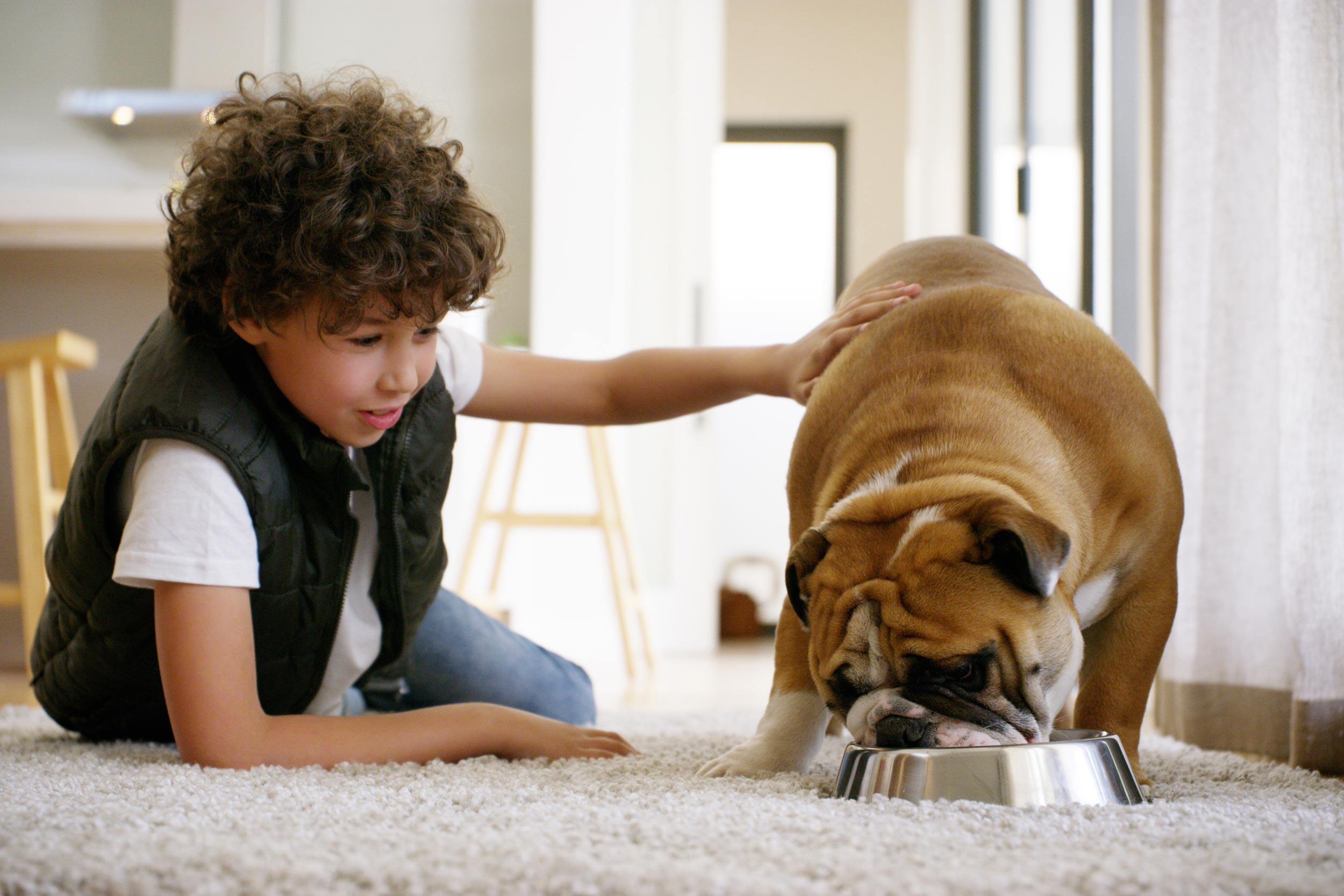
The Sneaky Truth About Pet Weight
You look at your dog every day, so it can be incredibly difficult to spot slow, subtle changes in their weight. We often only notice a difference when looking back at photos from a few years ago. “Wow, was he that lean before?”
It’s a common challenge: an estimated 56% of dogs in the United States are considered overweight or obese, yet many owners are unaware their pet is carrying excess weight. Carrying too much weight is a significant and preventable health risk, often leading to conditions like joint pain, breathing issues, and a reduced lifespan.
So, how do you know if your dog is truly “fat”?
The scale number is a helpful data point, but it isn’t the whole story. A healthy weight isn’t a single, rigid number for a breed; it’s about body condition. To assess this, veterinarians use a tool called the Body Condition Score (BCS). The good news is, you can learn to perform the same checks at home.
The At-Home BCS Check: A 3-Step Guide
To perform the BCS check, you will look at and feel your dog from three key angles. The goal is to identify and feel structural markers, not a thick layer of fat.
1. The Rib Check: The Ultimate Touch Test
This is the most critical step. Stand or kneel beside your dog and place your flat hands on both sides of their ribcage. Apply very light, gentle pressure.
-
Ideal (BCS 4-5): You should be able to easily feel individual ribs. They should feel similar to the back of your hand when your fingers are flat, or like feeling your knuckles when your hand is clenched into a fist.
-
Overweight (BCS 6-7): You must apply significant pressure to find the ribs through a palpable fat layer. They feel well-padded or soft.
-
Obese (BCS 8-9): You cannot feel the ribs at all, or only with extreme pressure, through a heavy layer of fat.
2. The Waist Check: The View From Above
Stand directly above your dog and look down. They should have a defined, visible curve, or “hourglass” figure, between their ribs and their hips.
-
Ideal: There is a discernible, smooth indent behind the ribcage and before the hips.
-
Overweight: The waist is barely visible, the line from ribs to hips is relatively straight, or there is a slight bulge.
-
Obese: There is no waist indentation, or the area actually bulges outwards significantly.
3. The Tummy Tuck Check: The View From the Side
Kneel down so you are at eye-level with your dog’s profile. Look at the line of their abdomen, from their front legs to their back legs.
-
Ideal: The abdomen should visibly tuck upwards and inwards behind the ribcage. It should not form a straight line parallel to the ground.
-
Overweight: The abdominal tuck is absent, less defined, or the profile is straight.
-
Obese: The abdomen bulges downward or seems “saggy” below the level of the ribcage.
Consistency is Key: Tracking Progress
Performing a BCS check once is useful, but the true value lies in monitoring consistency. Small changes add up, and if multiple caretakers are involved, accidental double-feeding is a major risk. A shared digital log like ifedthepet.app is essential to prevent overfeeding. Download ifedthepet.app today and help bring clarity and consistency to your dog’s feeding and monitoring routine.
Download I Fed the Pet Now!
Stop accidental double feeding, or forgetting to feed the pets.
One tap tells the household the pets have been fed.
Stop confusion & second dinners, keep feeding in sync.